
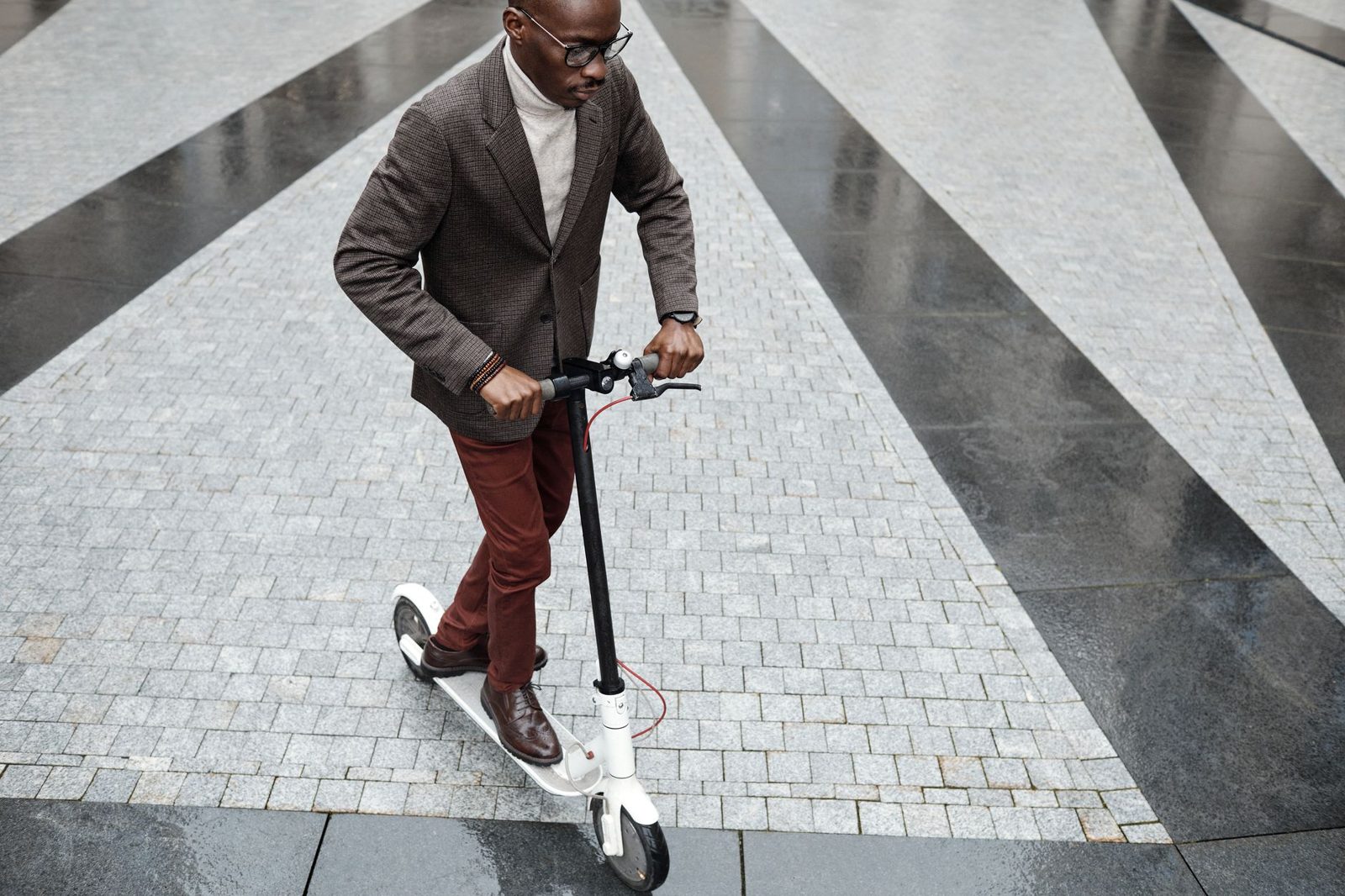
Quick answer: most people are best served by a commuter or lightweight folding e-scooter. Long-range, off-road and dual-motor models are heavier, faster and often outside what the law allows on public roads, seated models are a niche, and kids’ scooters are a separate low-speed category. Before you buy any of them, check whether you can legally ride it where you live.
Electric scooters are sold under a confusing mix of labels. Retailers talk about “commuter”, “portable”, “all-terrain” and “performance” models, but there is no official list of categories. What actually separates them is a handful of numbers on the spec sheet: weight, motor power, battery size, wheel and tyre size, brakes and suspension. This guide groups scooters by what they are designed to do, gives a real example of each with the manufacturer’s own figures, and points you to our detailed guide on each type.
The seven main types at a glance
| Type | Built for | Example (manufacturer figures) | Main trade-off |
|---|---|---|---|
| Commuter | Daily trips of a few miles on tarmac | Segway Ninebot MAX G2: 24.3kg, 551Wh battery, 25km/h top speed | Heavy to carry up stairs |
| Lightweight / folding | Mixing with trains, buses and car boots | Segway Ninebot Air T15: 10.5kg, 167Wh battery, about 20km/h | Short range, small wheels |
| Long-range | Long rides without recharging | Segway GT2 P: up to 90km claimed under test conditions | Weight, cost, charging time |
| Off-road / all-terrain | Gravel, grass and rough private land | Segway ZT3 Pro: 11-inch all-terrain tyres, front and rear suspension | Bulk, and usually private land only |
| Dual-motor performance | Speed, acceleration and hills | Segway GT2 P: two motors, 70km/h top speed | Far above most legal limits |
| Seated | Riders who want to sit down | Razor EcoSmart Metro HD: padded seat, 16-inch tyres, ages 16+ | Banned as an “e-scooter” in some places |
| Kids and teens | Younger riders on private land | Segway Ninebot ZING C8: ages 6 to 12, 16km/h maximum | Only suitable for supervised, off-road use |
Commuter e-scooters
Commuter scooters are the middle of the market. The Segway Ninebot MAX G2, for example, has a 450W rated motor (900W maximum), a 551Wh battery, 10-inch self-sealing tubeless tyres, front and rear suspension and a 120kg maximum load. Segway quotes about 50km of range at 25km/h, measured with a 75kg rider at 25°C on pavement. That is a good template for what “commuter” usually means: enough battery for a return trip, tyres that cope with patched roads, and a folding stem, but a weight that you will notice if you have to carry it.
Read more in our guide to commuter e-scooters.
Lightweight and folding e-scooters
If the scooter has to go up stairs or onto a train, weight matters more than anything else. Segway’s Air T15 weighs 10.5kg thanks to a mostly magnesium-alloy frame, but it has a 250W motor, a 167Wh battery, small 7.5-inch and 6-inch solid tyres, and a rated range of about 12km. Nearly every scooter folds, so the real question is how light and compact it is when folded.
Long-range e-scooters
Long-range scooters simply carry more battery. More battery means more weight and longer charging. Remember that range figures are measured under ideal conditions: Segway’s GT2 P figure of up to 90km was measured with a 75kg load, at 25°C, averaging 20km/h on pavement. Heavier riders, hills, cold weather and higher speeds all cut that number.
Off-road and all-terrain e-scooters
These scooters have bigger, knobblier tyres, longer suspension travel and more ground clearance. Segway describes the ZT3 Pro as all-terrain, with 11-inch tubeless tyres, a telescopic front fork and rear swingarm coil suspension, dual disc brakes and about 6 inches of ground clearance, weighing 65.5lb (about 30kg). They are designed for rough surfaces, which in the UK means private land only.
Dual-motor performance e-scooters
A second motor in the front wheel gives stronger acceleration, better hill climbing and all-wheel drive. Segway says the GT2 P reaches 70km/h and accelerates from 0 to 48km/h in 3.9 seconds. That is far faster than any legal e-scooter limit covered on this site, and faster than the 25km/h ceiling in the European PLEV safety standard EN 17128, which excludes vehicles designed to go faster than that.
Seated e-scooters
Some scooters come with a seat, or offer one as an accessory. The Razor EcoSmart Metro HD, for instance, has a padded seat, 16-inch pneumatic tyres, a 350W hub motor and a recommended minimum age of 16. Seats change the legal picture: Ireland does not allow seats on e-scooters, and Ontario’s pilot rules also rule them out. EN 17128 excludes vehicles that have a seat but are not self-balancing.
E-scooters for kids and teens
Children’s models are slower, lighter and lower powered. Segway’s ZING C8 is for ages 6 to 12 and riders 115 to 145cm tall, with a 16km/h top speed and a 10km/h “Safe” mode. Kids’ scooters are still covered by the same laws as adult ones, so in the UK that means private land only.
How to narrow it down
- Start with the law. If you cannot legally ride on public roads where you live, a big, fast scooter is money spent on something you can only use on private land.
- Be honest about weight. If you will carry it, look hard at scooters under about 15kg, and accept the smaller battery and wheels that come with them.
- Treat headline range as a best case. Plan on getting noticeably less than the headline figure, especially in winter or if you are heavier than the 75kg test rider many brands use.
- Look at tyres and brakes before speed. Consumer Reports, which tested 13 scooters in 2026 and recommended none, points out that small 8 to 12-inch wheels struggle on rough pavement.
- Check battery safety. London Fire Brigade says there is on average a fire from a lithium-ion battery in an e-bike or e-scooter every two days in London. Buy from a reputable seller and use the manufacturer’s charger.
Where you can legally ride one
The rules depend entirely on where you live, and they apply to every type of e-scooter, not just the fast ones.
- UK: the government says it is against the law to use a privately owned e-scooter on public land. Private e-scooters count as motor vehicles, so they can only be used on private land with the landowner’s permission. Rental e-scooters in official trial areas are the legal exception, limited to 15.5mph and needing a full or provisional licence with category Q entitlement.
- Ireland: e-scooters became legal on public roads on 20 May 2024, with a 20km/h maximum design speed, 400W power limit and 25kg weight limit, and seats are not allowed. Helmets and hi-vis became compulsory on 4 September 2026, and the minimum age of 16 was due to rise to 18 in early October 2026.
- Australia: each state sets its own rules. Victoria defines a legal e-scooter as having a maximum speed of 25km/h and weighing no more than 45kg. Queensland caps e-scooters at 25km/h and 12km/h on footpaths, and from 31 August 2026 riders must be 16 with at least a learner licence.
- Canada: rules are provincial and often local. Ontario’s pilot runs to 27 November 2029 and allows scooters up to 500W, 24km/h and 45kg only where a municipality has passed a bylaw.
- US: Consumer Reports notes there is no federal safety standard for adult consumer e-scooters, and it tells riders to check local laws, which vary by state and city.
The bottom line
Think of e-scooter types as points on a sliding scale. At one end are light, slow, short-range scooters that are easy to carry. At the other are heavy, fast, long-range machines that behave more like small motorbikes. Most riders are happiest somewhere in the middle, with a commuter scooter that suits their route and their local law. Whichever you choose, wear a helmet, keep your speed sensible and charge the battery safely.
Sources
- Segway: Ninebot KickScooter MAX G2 specifications (ap-en.segway.com)
- Segway: Ninebot KickScooter Air T15 specifications (ap-en.segway.com)
- Segway: eKickScooter GT2 P specifications (ee-en.segway.com)
- BGR: Segway announces new ZT3 Pro all-terrain electric scooter (bgr.com)
- Razor: EcoSmart Metro HD specifications (razor.com)
- Segway: Ninebot eKickScooter ZING C8 and C10 (eu-en.segway.com)
- Consumer Reports: We tested 13 electric scooters. We don’t recommend any (consumerreports.org)
- Genorma: EN 17128:2020 Personal light electric vehicles, requirements and test methods (genorma.com)
- London Fire Brigade: E-bikes and e-scooters fire safety advice (london-fire.gov.uk)
- GOV.UK: E-scooter trials, guidance for users
- GOV.UK: Guidance on powered transporters
- RTE News: What are the new e-scooter regulations? (May 2024) (rte.ie)
- RTE News: New helmet and high-vis e-scooter regulations in effect (September 2026) (rte.ie)
- Victoria Police: Electric powered scooters (e-scooters) (police.vic.gov.au)
- Queensland Government StreetSmarts: E-scooters, e-skateboards and e-unicycles (streetsmarts.initiatives.qld.gov.au)
- Government of Ontario: Electric kick-style scooters (e-scooters) (ontario.ca)