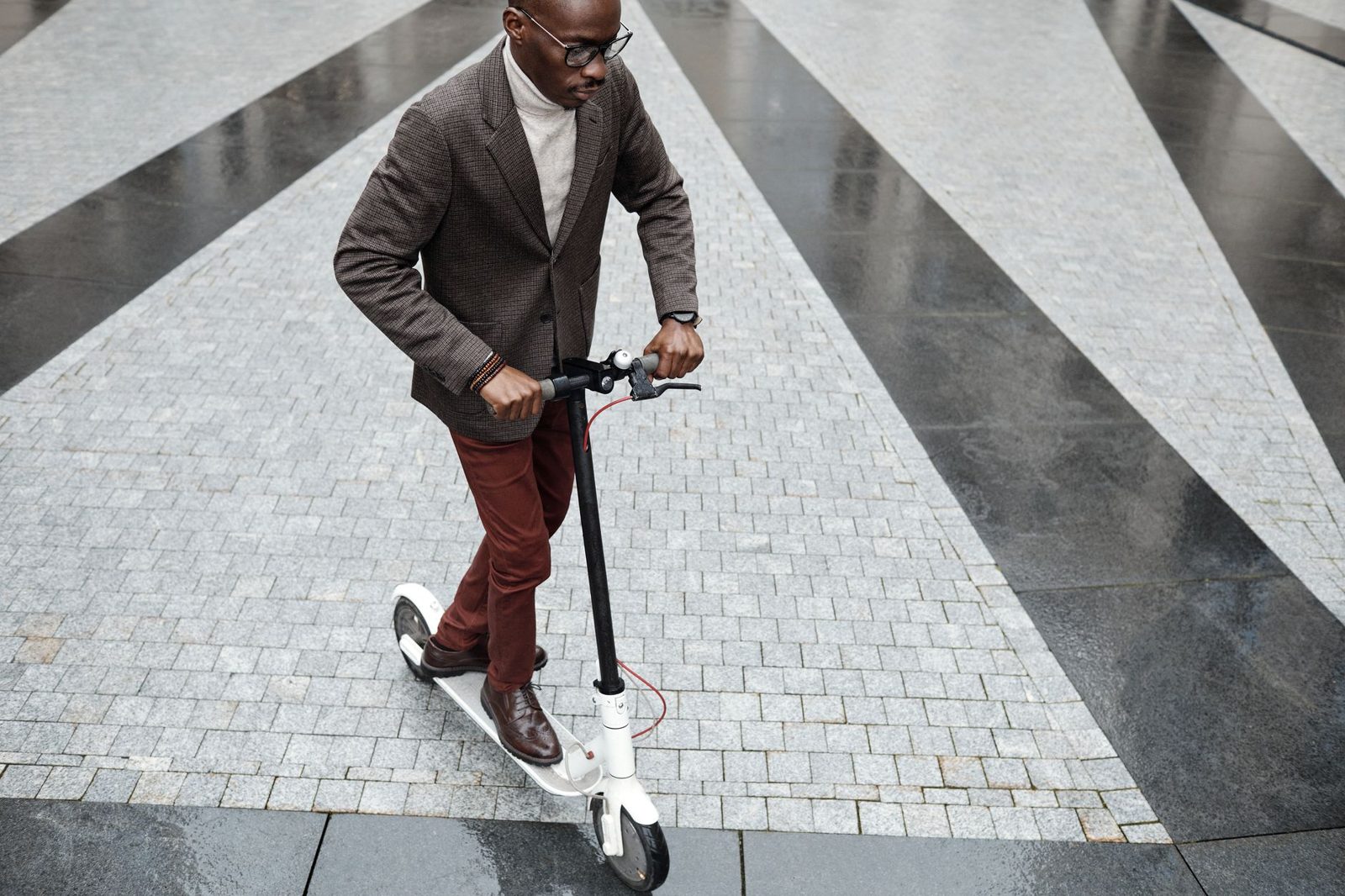
Quick answer: Premium electric scooters give you long range, stronger motors, dual suspension and, on most models, disc brakes front and rear. You pay for it in price and weight, and in some markets the faster versions cannot be ridden legally on public roads. Buy the version built for your country.
What counts as premium?
| Market | Currency | Premium band (approximate) |
|---|---|---|
| UK | GBP | about £700 to £1,400 |
| Ireland | EUR | about €800 to €1,600 |
| United States | USD | about US$1,000 to US$1,800 |
| Canada | CAD | about C$1,300 to C$2,400 |
| Australia | AUD | about A$1,500 to A$2,800 |
These are approximate price bands we use across this site to group scooters in each market. They are not exchange-rate conversions, and the same scooter can sit in a different band from one country to the next.
Premium scooters are often discounted. On the day we checked, Segway’s US store listed the Max G3 at US$999.99 against US$1,499.99, and NIU’s US shop listed the KQi Air at US$899 against US$1,499. We place models by their regular price.
What you typically get at this level
Motor and performance
Peak power jumps well beyond mid-range models. Segway quotes 2000 W maximum for the Max G3 and 1600 W for the ZT3 Pro, and Apollo quotes 1900 W peak for the City 2.0. In the US, that translates into higher top speeds: 28 mph for the Max G3 and 24.9 mph for the ZT3 Pro. In the UK and Europe, Segway sells E versions of the same scooters limited to about 25 km/h, with the extra power used for climbing. Segway quotes about 30% maximum slope for the MAX G3 E.
There is also a separate premium niche for very light scooters. NIU’s KQi Air uses a carbon fibre frame and weighs 26.2 lbs, with a 700 W maximum motor, so you are paying for low weight rather than raw power.
Battery, range and charging
Batteries in our examples reach around 600 Wh: 597 Wh for the Segway MAX G3 E and ZT3 Pro E, and 608.4 Wh for the NIU KQi 300X. Claimed ranges reach up to 50 miles (Max G3, at 10 mph). Faster charging starts to appear too. Segway quotes about 3.5 hours for the MAX G3 E, or about 2.5 hours with dual charging, against about 8 hours for the mid-range F3 E.
Weight
Most premium scooters are heavy. The MAX G3 E is 24.6 kg, the ZT3 Pro E 29.7 kg and the Apollo City 2.0 72 lbs (about 33 kg). If you need to carry your scooter regularly, the lightweight KQi Air is the exception.
Brakes
Disc brakes front and rear are typical. Segway lists double-action piston disc brakes front and rear on the MAX G3 E, and disc brakes front and rear on the ZT3 Pro E. NIU fits front and rear discs plus a rear electric brake on the KQi 300X. Not every premium model follows this pattern: the Apollo City 2.0 uses dual drum brakes with regenerative braking.
Suspension and tyres
Dual suspension is standard. The MAX G3 E has double hydraulic suspension at the front and double adjustable hydraulic suspension at the rear. The ZT3 Pro uses dual front telescopic and rear spring suspension with 11-inch all-road tyres. Self-sealing or self-healing tubeless tyres are common, listed on the Max G3, KQi 300X and City 2.0.
Build quality, water resistance and warranty
Water ratings are typically IPX5 to IP66. Segway rates the MAX G3 E body at IPX6 and its battery at IPX7, and Apollo rates the City 2.0 at IP66. Apollo lists certification to UL 2271 and UL 2272 for the City 2.0, and a 12-month limited warranty against manufacturing defects. Premium models also add tracking and security features, such as Apple Find My on the Segway MAX G3 E.
Example premium models
| Model (official page) | Key specs from the manufacturer | RRP at time of writing |
|---|---|---|
| Segway Max G3 (US) | 28 mph, up to 50 miles at 10 mph, 2000 W max power, front and rear disc brakes, dual adjustable hydraulic rear suspension, 11-inch self-sealing tyres. The UK MAX G3 E lists a 597 Wh battery, 24.6 kg, 130 kg payload, IPX6 body and about 3.5 hours to charge (Segway UK). | US$1,499.99 (Segway US store showed a sale price of US$999.99) |
| Segway ZT3 Pro (US) | 24.9 mph, up to 43.5 miles at 9.3 mph, 1600 W max power, dual front telescopic and rear spring suspension, 11-inch off-road tubeless tyres. The UK ZT3 Pro E lists a 597 Wh battery, 29.7 kg, front and rear disc brakes and IPX5 (Segway UK). | US$1,299.99 (Segway US store showed a sale price of US$999.99) |
| NIU KQi 300X (US) | Top speed 20 mph, range up to 37.3 miles, 608.4 Wh battery, 48.7 lbs, all-terrain suspension, 10.5-inch self-healing tubeless tyres, front and rear disc brakes plus rear electric brake. | US$1,299 (NIU US shop showed a sale price of US$899) |
| NIU KQi Air (US) | Carbon fibre frame, 26.2 lbs, top speed 20 mph, 31 mile range, 700 W max power, 9.5-inch tubeless tyres, mechanical disc brake plus regenerative braking. | US$1,499 (NIU US shop showed a sale price of US$899) |
| Apollo City 2.0 (Canada) | 51 km/h top speed, 1900 W peak, 48V 18Ah battery, 72 km range in Eco mode, 72 lbs, dual drum brakes plus regenerative braking, triple spring suspension, 10-inch self-healing tubeless tyres, IP66, 12-month limited warranty. | C$1,799 (Apollo Canada store) |
What to watch out for
- Legal speed limits. A 51 km/h Apollo City 2.0 is more than twice the 24 km/h maximum in Ontario’s e-scooter pilot. Queensland requires personal mobility devices to be unable to exceed 25 km/h under motor power, and Ireland caps e-scooters at 20 km/h and 25 kg.
- Weight limits in law. Ireland’s 25 kg limit rules out the heavier premium models, and Queensland caps devices at 60 kg.
- Age guidance. Segway recommends 16+ for the MAX G3 E, and Apollo says its scooters are designed for adults aged 18 and over.
- Sale pricing. Deep discounts are common. Compare against the regular price on the official store rather than a third-party “was” price.
- Charging safety. Bigger batteries hold more energy. Follow fire service advice: never charge while asleep or away, and do not block your escape route (London Fire Brigade).
Check the law before you buy
- UK: it is against the law to use a privately owned e-scooter on public land. Private e-scooters can be used on private land with the landowner’s permission. Only rental e-scooters in official trial areas can be ridden on roads (GOV.UK trial guidance, GOV.UK powered transporters guidance).
- Ireland: e-scooters must weigh no more than 25 kg, travel at 20 km/h or less, have a motor of 400 watts or less and wheels of at least 200 mm, among other requirements (Citizens Information).
- Canada: rules are provincial and often municipal. Ontario’s pilot sets a 24 km/h maximum speed, 500 watt maximum power and 45 kg maximum weight, and only applies where a municipality has opted in (Government of Ontario).
- Australia: it is currently illegal to ride privately owned e-scooters in public places in NSW (NSW Government). Queensland limits personal mobility devices to 25 km/h and 60 kg (Queensland Government).
- United States: rules vary by state and city. California, for example, sets a 15 mph maximum speed for motorised scooters and requires a helmet for riders under 18 (California Vehicle Code 21235).
Is premium worth it?
If you ride long distances, face big hills, or want a smoother ride on poor surfaces, a premium scooter is a genuine step up in comfort, range and braking. If you mainly need something light for the last mile, a mid-range model or a lightweight premium option like the KQi Air may suit you better.
Sources
- Segway Max G3 (Segway US official store) (store.segway.com)
- Segway Ninebot MAX G3 E specifications (Segway UK) (uk-en.segway.com)
- Segway ZT3 Pro (Segway US official store) (store.segway.com)
- Segway ZT3 Pro E specifications (Segway UK) (uk-en.segway.com)
- NIU KQi 300X Electric Scooter (NIU official US shop) (shop.niu.com)
- NIU KQi Air Electric Scooter (NIU official US shop) (shop.niu.com)
- Apollo City 2.0 (Apollo Scooters Canada) (apolloscooters.ca)
- Segway Ninebot F3 E specifications (Segway UK) (uk-en.segway.com)
- Segway electric scooters range and prices (Segway US official store) (store.segway.com)
- How to charge e-bikes and e-scooters safely (London Fire Brigade) (london-fire.gov.uk)
- E-scooter trials: guidance for users (GOV.UK)
- Guidance on powered transporters (GOV.UK)
- E-scooters (Citizens Information, Ireland) (citizensinformation.ie)
- Electric kick-style scooters (e-scooters) (Government of Ontario) (ontario.ca)
- Riding electric scooters in NSW (NSW Government) (nsw.gov.au)
- Rules for personal mobility devices (Queensland Government) (qld.gov.au)
- California Vehicle Code section 21235 (california.public.law)