
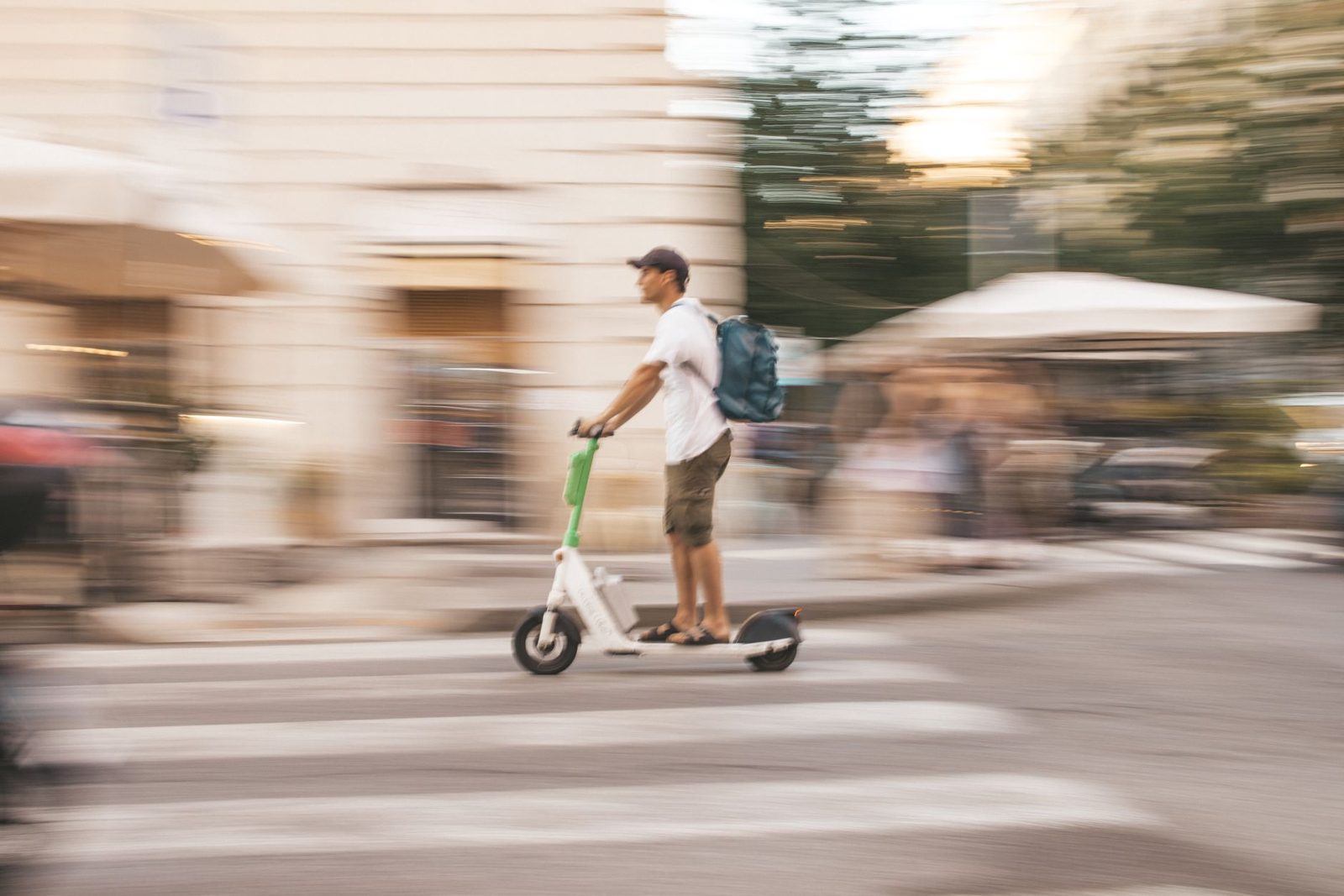
Quick answer: a good commuter e-scooter has enough real-world range for your round trip with plenty to spare, 10-inch or larger tyres, two independent brakes, proper lights, some water resistance and a weight you can manage. It also needs to be legal where you ride: in the UK, private e-scooters cannot be used on public roads.
A commuter scooter has one job: get you to work and back, every day, in whatever weather your climate throws at it. That sounds simple, but it means the dull specs matter more than the exciting ones. Top speed is largely irrelevant when most legal limits sit between 20 and 25km/h. Tyres, brakes, lights and a battery that still gets you home in January matter much more.
A real example: what a mid-range commuter looks like
To make the specs concrete, here is what Segway lists for its Ninebot MAX G2, a popular commuter model. We are not recommending it over anything else, just using it as a reference point.
| Spec | Segway Ninebot MAX G2 (manufacturer figures) |
|---|---|
| Weight | 24.3kg |
| Motor | 450W rated, 900W maximum |
| Battery | 551Wh |
| Top speed | 25km/h |
| Range | About 50km at 25km/h, 55km at 20km/h, 70km at 12km/h |
| Range test conditions | Full battery, 75kg load, 25°C, on pavement |
| Tyres | 10-inch self-sealing tubeless |
| Brakes | Front drum plus rear electronic brake |
| Suspension | Hydraulic front, double rear |
| Water resistance | IPX5 scooter body, IPX7 battery pack |
| Maximum load | 120kg |
| Charging time | About 6 hours |
Notice how the range changes with speed. The same battery gives about 70km at 12km/h but only about 50km at 25km/h. That pattern holds for every scooter, which is why you should always read the small print under the range figure.
Range: plan for the bad days
Manufacturers measure range under kind conditions: a fairly light rider, mild temperatures and flat pavement. Your commute probably includes hills, stop-start junctions, a headwind and, for half the year, cold weather. A sensible approach is to work out your round-trip distance and choose a scooter whose rated range at your likely speed is comfortably more than that, so you are not relying on the last few percent of charge. If you can charge at work, you have more flexibility; if you cannot, build in a bigger buffer.
Tyres and suspension
Commuting means potholes, drain covers and patched tarmac. Consumer Reports, which tested 13 e-scooters in 2026 and did not recommend any of them, highlights that small wheels of 8 to 12 inches struggle on rough pavement, and that the standing position makes falls more serious. For commuting:
- Tyre size: 10 inches is a reasonable minimum for city roads. Bigger wheels roll over bumps more easily.
- Tyre type: air-filled (pneumatic) tyres grip and absorb bumps better but can puncture. Tubeless and self-sealing designs reduce the hassle. Solid tyres never puncture but give a harsher ride.
- Suspension: not essential on smooth roads, but it makes a big difference to comfort and control on poor surfaces.
Brakes
Look for two independent brakes, ideally at least one mechanical brake (drum or disc) rather than relying only on the motor’s electronic braking. Ireland’s rules, for example, require two independent braking systems on any e-scooter used on public roads. Consumer Reports also warns that braking while turning can make the rear wheel skid, so practise braking in a straight line before you ride in traffic.
Lights and visibility
Most commutes include some riding in the dark for part of the year. Front and rear lights are required on e-scooters in Ireland, Victoria, Queensland and Ontario. Built-in lights on many scooters are fine for being seen but not always for seeing the road, so consider adding a brighter front light. Since 4 September 2026, riders in Ireland must also wear hi-vis and a helmet.
Water resistance and the IP rating
IP ratings come from the international standard IEC 60529. The first digit is protection against dust and solids, the second against water, and an “X” means that part was not rated. On the water scale, 4 means protection against splashing, 5 against water jets, 6 against powerful jets and 7 against temporary immersion up to one metre. For all-weather commuting, a higher water rating gives you more margin. An IP rating describes a laboratory test rather than a promise about everyday use, so also check what the manual and warranty say about riding in rain and cleaning the scooter.
Weight and folding
A commuter scooter in the 20 to 25kg range is fine if you ride door to door and store it on the ground floor. It becomes a real problem if you have stairs at either end or want to take it on a train. If that is you, read our guide to lightweight and folding scooters and weigh up whether a shorter range is a price worth paying.
Charging and storing it at home or work
London Fire Brigade says there is on average a fire from a lithium-ion battery in an e-bike or e-scooter every two days in London, and that many happen during charging. The National Fire Chiefs Council advises charging while you are awake and alert, never overnight or while you are out, using only the manufacturer’s charger, and not storing scooters on escape routes such as hallways. The government’s safety message adds: buy from a known seller, follow the manufacturer’s instructions and unplug the charger once charging has finished.
Where you can legally ride one
The rules depend entirely on where you live, and they apply to every type of e-scooter, not just the fast ones.
- UK: the government says it is against the law to use a privately owned e-scooter on public land. Private e-scooters count as motor vehicles, so they can only be used on private land with the landowner’s permission. Rental e-scooters in official trial areas are the legal exception, limited to 15.5mph and needing a full or provisional licence with category Q entitlement.
- Ireland: e-scooters became legal on public roads on 20 May 2024, with a 20km/h maximum design speed, 400W power limit and 25kg weight limit, and seats are not allowed. Helmets and hi-vis became compulsory on 4 September 2026, and the minimum age of 16 was due to rise to 18 in early October 2026.
- Australia: each state sets its own rules. Victoria defines a legal e-scooter as having a maximum speed of 25km/h and weighing no more than 45kg. Queensland caps e-scooters at 25km/h and 12km/h on footpaths, and from 31 August 2026 riders must be 16 with at least a learner licence.
- Canada: rules are provincial and often local. Ontario’s pilot runs to 27 November 2029 and allows scooters up to 500W, 24km/h and 45kg only where a municipality has passed a bylaw.
- US: Consumer Reports notes there is no federal safety standard for adult consumer e-scooters, and it tells riders to check local laws, which vary by state and city.
Commuter checklist
- Rated range at your normal speed comfortably exceeds your round trip.
- Tyres of at least 10 inches, pneumatic or tubeless if your roads are rough.
- Two independent brakes, ideally including a mechanical one.
- Front and rear lights, and reflectors.
- A water-resistance rating you are comfortable with for your climate.
- A weight you can actually lift where you need to.
- A maximum load rating that covers you plus your bag.
- Bought from a reputable seller, with the manufacturer’s charger.
- Legal for the roads you plan to use.
Sources
- Segway: Ninebot KickScooter MAX G2 specifications (ap-en.segway.com)
- Consumer Reports: We tested 13 electric scooters. We don’t recommend any (consumerreports.org)
- Applus+ Keystone: IEC 60529 Ingress Protection (IP code) (keystonecompliance.com)
- London Fire Brigade: E-bikes and e-scooters fire safety advice (london-fire.gov.uk)
- National Fire Chiefs Council: E-bikes and e-scooters fire safety guidance (nfcc.org.uk)
- GOV.UK: Government safety message on e-bikes and e-scooters
- GOV.UK: E-scooter trials, guidance for users
- GOV.UK: Guidance on powered transporters
- RTE News: What are the new e-scooter regulations? (May 2024) (rte.ie)
- RTE News: New helmet and high-vis e-scooter regulations in effect (September 2026) (rte.ie)
- Victoria Police: Electric powered scooters (e-scooters) (police.vic.gov.au)
- Queensland Government StreetSmarts: E-scooters, e-skateboards and e-unicycles (streetsmarts.initiatives.qld.gov.au)
- Government of Ontario: Electric kick-style scooters (e-scooters) (ontario.ca)