
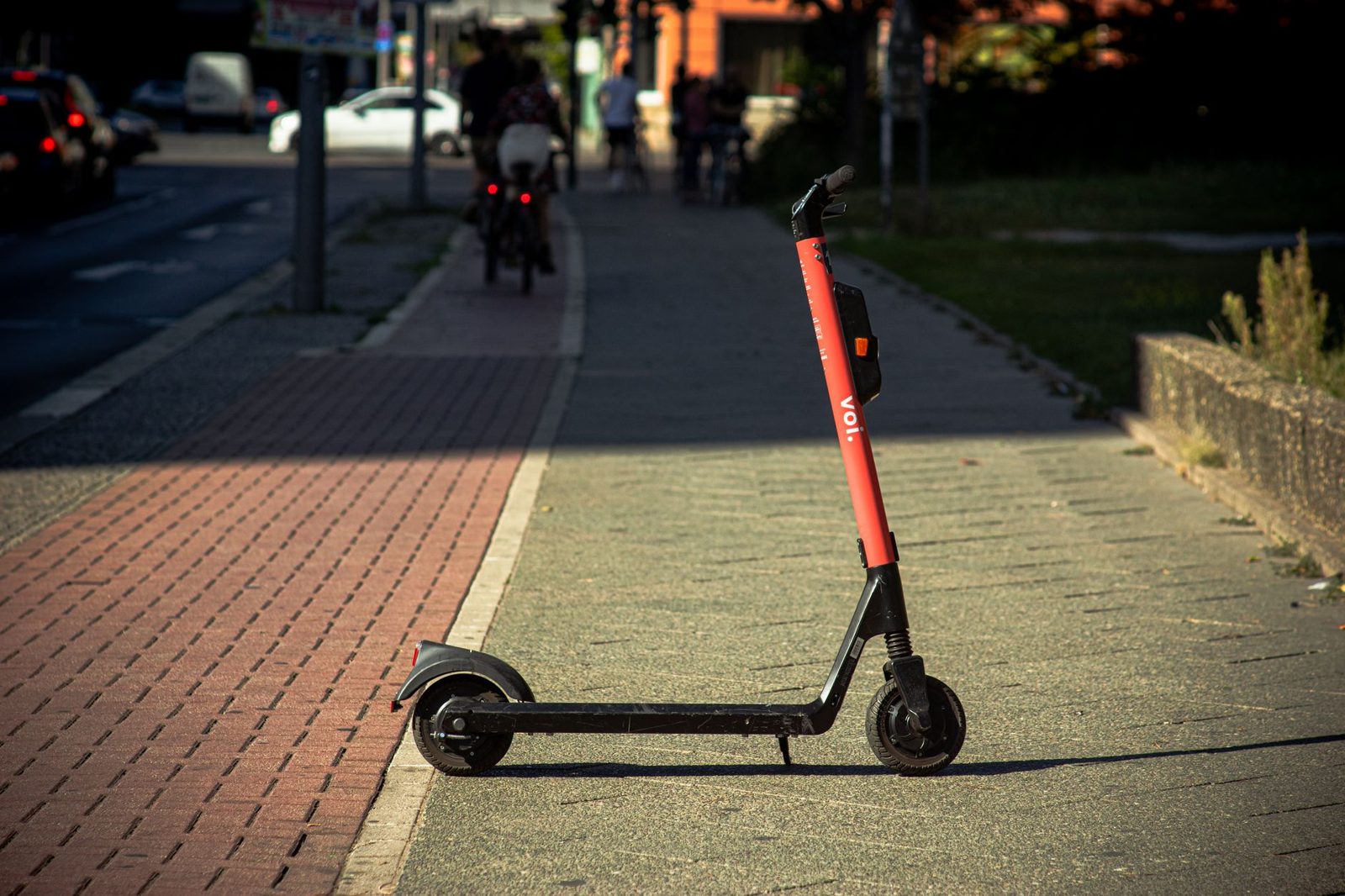
Quick answer: lightweight e-scooters weigh roughly half as much as a typical commuter model, which makes them far easier to carry on stairs, trains and buses. The price is a smaller battery, lower power, smaller wheels and often lower rider weight limits. They suit short trips on smooth surfaces, combined with public transport.
Almost every electric scooter folds, so “folding” on its own tells you very little. What matters is how heavy the scooter is, how small it gets when folded, and how quickly and securely the folding mechanism works. If you have to carry a scooter regularly, a few kilograms makes a real difference to whether you actually use it.
The weight trade-off in real numbers
Comparing two scooters from the same manufacturer shows what you give up. These are Segway’s own published figures.
| Spec | Ninebot Air T15 (lightweight) | Ninebot MAX G2 (commuter) |
|---|---|---|
| Weight | 10.5kg | 24.3kg |
| Motor | 250W nominal | 450W rated, 900W maximum |
| Battery | 167Wh | 551Wh |
| Top speed | About 20km/h | 25km/h |
| Rated range | About 12km at 12km/h | About 70km at 12km/h |
| Tyres | 7.5-inch front, 6-inch rear, solid rubber | 10-inch self-sealing tubeless |
| Water resistance | IPX4 | IPX5 body, IPX7 battery |
| Rider load | 30 to 100kg | Up to 120kg |
Both range figures were measured with a 75kg load at 25°C on pavement. The Air T15 is less than half the weight, but its battery is under a third of the size, and its rated range at the same speed is much shorter. Segway also lists a rider age range of 14 to 60 and a height range of 130 to 200cm for the Air T15, which is a reminder to check the manufacturer’s rider limits, not just the maximum weight.
Where the weight is saved
- Frame material: Segway says 90% of the Air T15’s metal parts, including the frame, are magnesium alloy, which is lighter than the aluminium used on many scooters.
- Battery: the battery is one of the heaviest parts of a scooter, so light scooters carry smaller ones.
- Motor and wheels: smaller hub motors and smaller wheels save weight but reduce hill-climbing and comfort.
- Suspension: many lightweight scooters have little or none. Segway does not list suspension for the Air T15.
Small wheels: the biggest compromise
Consumer Reports, which tested 13 scooters in 2026 and recommended none, says small wheels of 8 to 12 inches struggle on rough pavement, and that the standing position means riders tend to fall forwards. Wheels smaller than that, as found on many ultra-light scooters, make potholes, drain covers and kerb edges even more of a hazard. Solid tyres never go flat but transmit more vibration and can have less grip in the wet. If your route is rough, a light scooter may be the wrong tool.
Braking on lightweight scooters
Lightweight models sometimes use simpler braking. Segway lists the Air T15’s braking as electronic braking combined with stepping on the rear fender. That can work at modest speeds on dry surfaces, but it is less reassuring in the wet than a hand-operated mechanical brake. Wherever you ride, practise emergency stops before using the scooter around other people.
Folding: what to check
- Folded size: Segway lists the Air T15 at 1,024 x 202 x 223mm folded. Measure your car boot, desk space or luggage rack before buying.
- Latch security: the folding joint takes a lot of load. It should lock firmly with no play in the stem.
- Carry point: check there is a comfortable place to grip the folded scooter.
- Rules on public transport: operators set their own policies on carrying e-scooters, and some ban them. Check before you rely on one for a mixed journey.
Range: be realistic
With a battery of under 200Wh, you should not expect much more than the manufacturer’s rated range, and you should expect less in cold weather, on hills or if you weigh more than the 75kg test rider. For a light scooter, the rated range is best treated as a ceiling. Choose one whose rated range is comfortably more than your longest planned trip.
Battery safety still applies
A small battery is still a lithium-ion battery. London Fire Brigade says there is on average a fire from a lithium-ion battery in an e-bike or e-scooter every two days in London. The National Fire Chiefs Council advises charging only while you are awake, using the manufacturer’s charger, not covering the charger and not storing scooters on escape routes. The government’s safety message says to buy from a known seller and never modify or tamper with the battery.
Where you can legally ride one
The rules depend entirely on where you live, and they apply to every type of e-scooter, not just the fast ones.
- UK: the government says it is against the law to use a privately owned e-scooter on public land. Private e-scooters count as motor vehicles, so they can only be used on private land with the landowner’s permission. Rental e-scooters in official trial areas are the legal exception, limited to 15.5mph and needing a full or provisional licence with category Q entitlement.
- Ireland: e-scooters became legal on public roads on 20 May 2024, with a 20km/h maximum design speed, 400W power limit and 25kg weight limit, and seats are not allowed. Helmets and hi-vis became compulsory on 4 September 2026, and the minimum age of 16 was due to rise to 18 in early October 2026.
- Australia: each state sets its own rules. Victoria defines a legal e-scooter as having a maximum speed of 25km/h and weighing no more than 45kg. Queensland caps e-scooters at 25km/h and 12km/h on footpaths, and from 31 August 2026 riders must be 16 with at least a learner licence.
- Canada: rules are provincial and often local. Ontario’s pilot runs to 27 November 2029 and allows scooters up to 500W, 24km/h and 45kg only where a municipality has passed a bylaw.
- US: Consumer Reports notes there is no federal safety standard for adult consumer e-scooters, and it tells riders to check local laws, which vary by state and city.
Who should buy a lightweight e-scooter?
- Good fit: short, smooth trips where the scooter spends part of the journey being carried, such as the last mile from a station, and where it is legal to ride.
- Poor fit: long commutes, hilly routes, rough roads, heavier riders near the maximum load, or daily riding in heavy rain.
If you are torn, weigh the scooter you are considering against something familiar, such as a full suitcase, and imagine carrying it up your stairs twice a day. That usually settles the question.
Sources
- Segway: Ninebot KickScooter Air T15 specifications (ap-en.segway.com)
- Segway: Ninebot KickScooter MAX G2 specifications (ap-en.segway.com)
- Consumer Reports: We tested 13 electric scooters. We don’t recommend any (consumerreports.org)
- Applus+ Keystone: IEC 60529 Ingress Protection (IP code) (keystonecompliance.com)
- London Fire Brigade: E-bikes and e-scooters fire safety advice (london-fire.gov.uk)
- National Fire Chiefs Council: E-bikes and e-scooters fire safety guidance (nfcc.org.uk)
- GOV.UK: Government safety message on e-bikes and e-scooters
- GOV.UK: E-scooter trials, guidance for users
- GOV.UK: Guidance on powered transporters
- RTE News: What are the new e-scooter regulations? (May 2024) (rte.ie)
- RTE News: New helmet and high-vis e-scooter regulations in effect (September 2026) (rte.ie)
- Victoria Police: Electric powered scooters (e-scooters) (police.vic.gov.au)
- Queensland Government StreetSmarts: E-scooters, e-skateboards and e-unicycles (streetsmarts.initiatives.qld.gov.au)
- Government of Ontario: Electric kick-style scooters (e-scooters) (ontario.ca)