
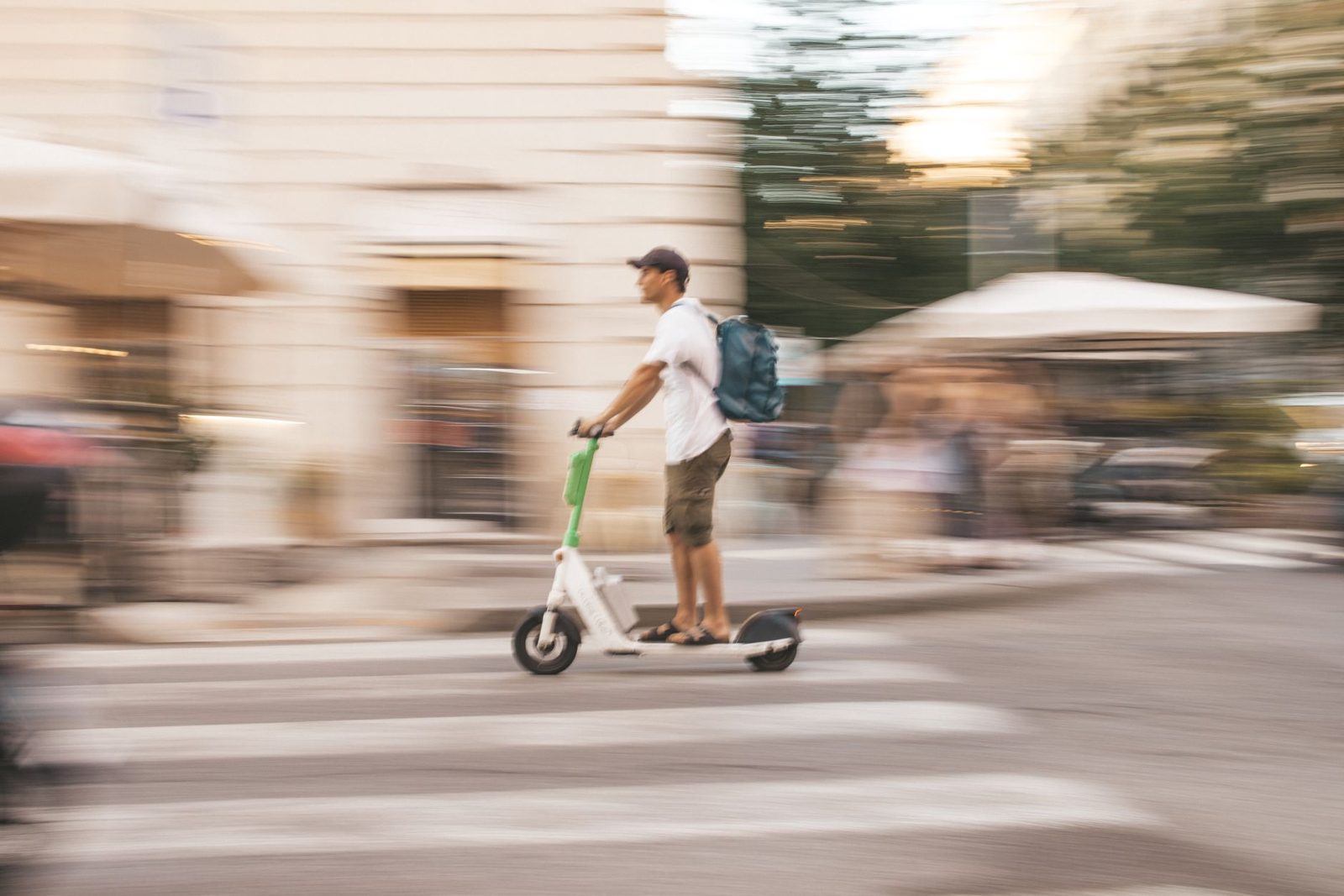
Quick answer: Mid-range electric scooters are where most commuters get the best balance. Compared with budget models you typically get a stronger motor, a battery of around 360 to 490 Wh, bigger air-filled tyres, better suspension and, on some models, disc brakes. The trade-off is weight, often 20 kg or more.
What counts as mid-range?
| Market | Currency | Mid-range band (approximate) |
|---|---|---|
| UK | GBP | about £350 to £700 |
| Ireland | EUR | about €400 to €800 |
| United States | USD | about US$450 to US$1,000 |
| Canada | CAD | about C$600 to C$1,300 |
| Australia | AUD | about A$700 to A$1,500 |
These are approximate price bands we use across this site to group scooters in each market. They are not exchange-rate conversions, and the same scooter can sit in a different band from one country to the next.
Sales can push a scooter into a lower band for a while. On the day we checked, NIU’s US shop had the KQi 200P at US$419 against a regular US$649, and the KQi 300P at US$749 against a regular US$899. We group models by their regular price where the official store shows one.
What you typically get at this level
Motor and hill climbing
Rated motor power moves up to around 400 to 500 W, with peaks of up to 1000 W. Xiaomi lists 400 W rated and 1000 W maximum for both the Electric Scooter 5 Pro and 5 Max, and Segway lists 450 W nominal and 1000 W maximum for the UK F3 E. The practical benefit is on hills: Xiaomi quotes about 22% maximum incline for the 5 Pro and 5 Max against about 18% for the standard Electric Scooter 5, and Segway quotes about 20% for the F3 E.
Battery and range
Batteries in our examples range from 365 Wh (NIU KQi 200P) to 486 Wh (NIU KQi 300P), with Xiaomi and Segway both at 477 Wh. Claimed ranges run from about 30 miles (48 km) up to 44 miles (about 70 km), depending on the test speed. Segway’s UK page shows how much speed matters: the F3 E is quoted at about 50 km at 25 km/h but about 70 km at 15 km/h. Charging takes longer too. Xiaomi quotes about 9 hours and Segway about 8 hours for the F3 E.
Weight
Expect roughly 18.5 to 22.5 kg (about 41 to 46 lbs). The Segway F3 E is 18.6 kg, the Xiaomi 5 Pro 22.4 kg and the NIU KQi 300P 45.97 lbs (about 20.9 kg). That is manageable for short carries but noticeably heavier than a budget model.
Brakes
This is the band where disc brakes start to appear. The NIU KQi 300P has front and rear disc brakes plus a rear electric brake, and the Segway F3 E has a front disc brake with a rear electronic brake. Other mid-range models, such as the Xiaomi 5 Pro and 5 Max and the NIU KQi 200P, stick with drum brakes plus electronic or regenerative braking.
Suspension and tyres
Front suspension is common and some models add rear suspension. Segway pairs front hydraulic with rear elastomer suspension on the F3, and NIU describes the KQi 300P as having all-terrain suspension. Tyres are typically 10 to 10.5-inch tubeless, and several brands now fit self-sealing tyres, which Segway lists on the F3.
Build quality, water resistance and extras
Water resistance ratings tend to improve. Xiaomi rates its 5 series at IPX5, while Segway rates the F3 E body at IPX6 and its battery pack at IPX7. You also get more features: turn indicators, app control, and on the F3 E, Apple Find My tracking and navigation. The F3 E also carries a 120 kg maximum payload.
Example mid-range models
Specs below are from each manufacturer’s official page. Check the version sold in your country, as speed and battery details can differ.
| Model (official page) | Key specs from the manufacturer | RRP at time of writing |
|---|---|---|
| Xiaomi Electric Scooter 5 Pro (UK) | 25 km/h, approx. 60 km range, 477 Wh battery, 400 W rated (1000 W max), 22.4 kg, 120 kg max load, drum brakes and E-ABS, 10-inch tubeless tyres, IPX5. | £449.99 (Xiaomi UK store) |
| Xiaomi Electric Scooter 5 Max (UK) | 25 km/h, 60 km range, 477 Wh battery, 400 W rated (1000 W max), 22.3 kg, 22% max incline, drum brakes and E-ABS, 10-inch tubeless tyres, IPX5. | £499.99 (Xiaomi UK store) |
| NIU KQi 200P (US) | Top speed 20 mph, range up to 33.6 miles, 365 Wh battery, 43.4 lbs, front dual-tube spring suspension (32 mm stroke), 10-inch tubeless pneumatic tyres, front drum and rear regenerative braking. | US$649 (NIU US shop showed a sale price of US$419) |
| NIU KQi 300P (US) | Top speed 20 mph, range up to 30 miles, 486 Wh battery, 45.97 lbs, all-terrain suspension, 10.5-inch tubeless pneumatic tyres, front and rear disc brakes plus rear electric brake. | US$899 (NIU US shop showed a sale price of US$749) |
| Segway F3 (US) | 20 mph, up to 44 miles at 9 mph, 1000 W max power, front hydraulic and rear elastomer suspension, 10-inch self-sealing tyres. The UK F3 E version lists a 477 Wh battery, 18.6 kg, front disc and rear electronic brake, IPX6 body and IPX7 battery (Segway UK). | US$999.99 (Segway US store) |
What to watch out for
- Weight creep. An extra 3 to 5 kg over a budget model matters if you carry the scooter up stairs every day.
- Speed versus the law. A US model quoted at 20 mph (about 32 km/h) is faster than the 24 km/h limit in Ontario’s pilot and the 20 km/h limit for e-scooters in Ireland. Buy the version made for your market.
- Range at real speeds. Headline range is often measured at a low speed. Look for a figure at the speed you will actually ride.
- Charger and battery compatibility. Use only the charger supplied or one recommended by the manufacturer. The London Fire Brigade warns that the wrong charger can overload the battery and increase the risk of fire (London Fire Brigade).
- Brake maintenance. Disc brakes are stronger but need pads checked and adjusted. See our maintenance guide.
Check the law before you buy
- UK: it is against the law to use a privately owned e-scooter on public land. Private e-scooters can be used on private land with the landowner’s permission. Only rental e-scooters in official trial areas can be ridden on roads (GOV.UK trial guidance, GOV.UK powered transporters guidance).
- Ireland: e-scooters must weigh no more than 25 kg, travel at 20 km/h or less, have a motor of 400 watts or less and wheels of at least 200 mm, among other requirements (Citizens Information).
- Canada: rules are provincial and often municipal. Ontario’s pilot sets a 24 km/h maximum speed, 500 watt maximum power and 45 kg maximum weight, and only applies where a municipality has opted in (Government of Ontario).
- Australia: it is currently illegal to ride privately owned e-scooters in public places in NSW (NSW Government). Queensland limits personal mobility devices to 25 km/h and 60 kg (Queensland Government).
- United States: rules vary by state and city. California, for example, sets a 15 mph maximum speed for motorised scooters and requires a helmet for riders under 18 (California Vehicle Code 21235).
Who should buy mid-range?
If you ride most days, cover a few miles each way, have hills on your route or weigh more than a budget model allows, the mid-range band is usually the sweet spot. If you want long range, dual suspension and stronger brakes all together, look at our premium guide next.
Sources
- Xiaomi Electric Scooter 5 Pro specs (Xiaomi UK) (mi.com)
- Xiaomi Electric Scooter 5 Max specs (Xiaomi UK) (mi.com)
- Xiaomi Electric Scooter 5 specs (Xiaomi UK) (mi.com)
- NIU KQi 200P Electric Scooter (NIU official US shop) (shop.niu.com)
- NIU KQi 300P Electric Scooter (NIU official US shop) (shop.niu.com)
- Segway F3 eKickScooter (Segway US official store) (store.segway.com)
- Segway Ninebot F3 E specifications (Segway UK) (uk-en.segway.com)
- How to charge e-bikes and e-scooters safely (London Fire Brigade) (london-fire.gov.uk)
- E-scooter trials: guidance for users (GOV.UK)
- Guidance on powered transporters (GOV.UK)
- E-scooters (Citizens Information, Ireland) (citizensinformation.ie)
- Electric kick-style scooters (e-scooters) (Government of Ontario) (ontario.ca)
- Riding electric scooters in NSW (NSW Government) (nsw.gov.au)
- Rules for personal mobility devices (Queensland Government) (qld.gov.au)
- California Vehicle Code section 21235 (california.public.law)