
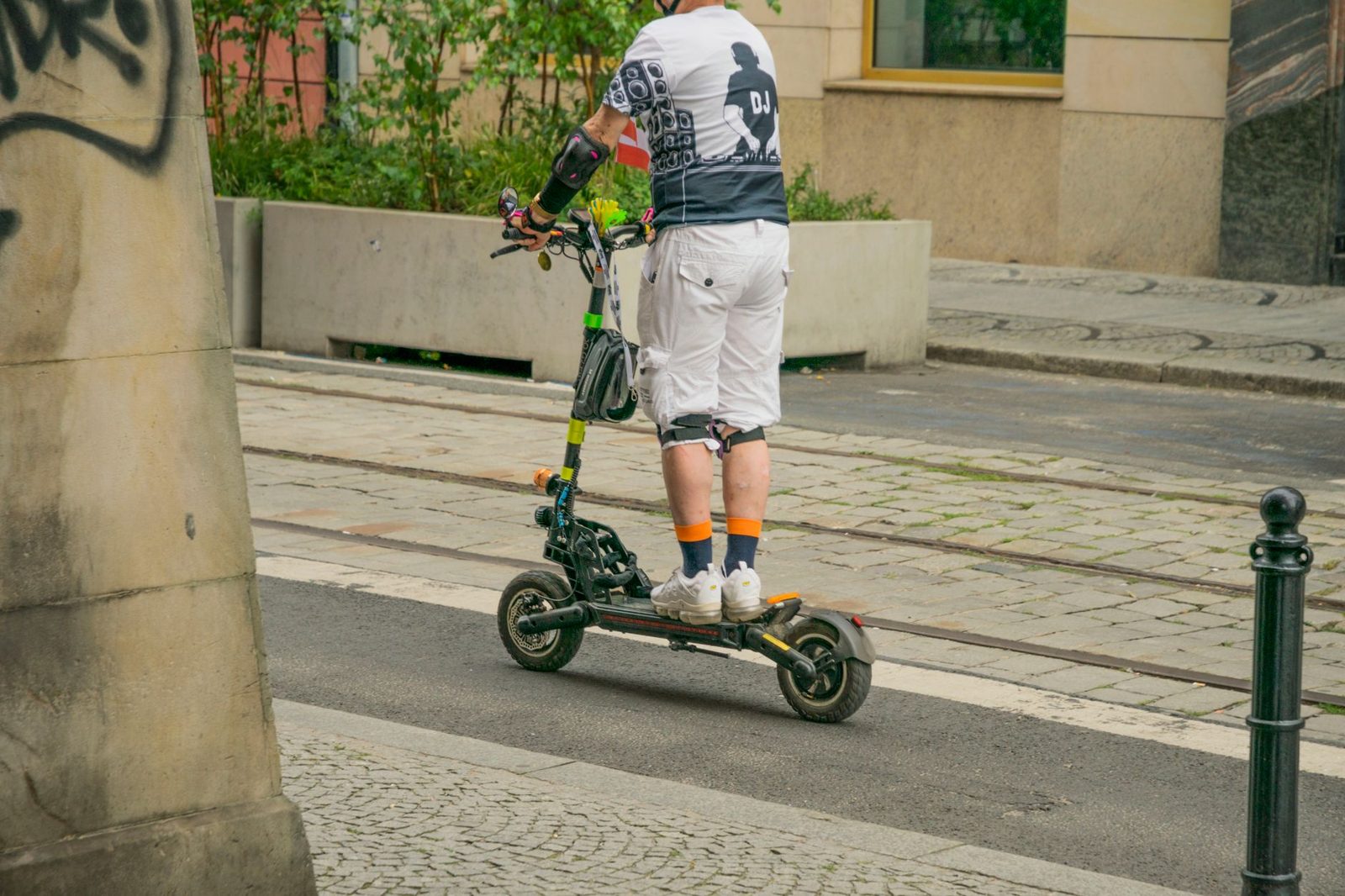
Quick answer: a dual-motor e-scooter has a motor in each wheel, giving two-wheel drive, strong acceleration and better hill-climbing. Most are heavy, expensive and capable of speeds far above the legal e-scooter limits in the UK, Ireland, Canada and Australia, so in practice they are for private land. Their braking, tyres and protective kit need to match their speed.
Performance scooters are the fastest-growing corner of the e-scooter market. Consumer Reports notes that in 2022 most scooters it saw were limited to 15.5mph, but that 20mph is now a common top speed and some models reach 28mph. Dual-motor machines go much further than that. Before you look at one, it helps to understand what the second motor actually does, and what it means for safety and legality.
What a second motor does
- Traction: driving both wheels spreads the power, which helps on loose surfaces and steep slopes.
- Acceleration: two motors can deliver much more total power.
- Hill-climbing: more power means less slowing down on steep gradients.
- Flexibility: many dual-motor scooters let you switch between single and dual drive to save battery.
A real example
Segway’s GT2 P is a good illustration of how far performance scooters have moved from commuter models. From Segway’s spec page:
| Spec | Segway GT2 P | Segway Ninebot MAX G2 (commuter, for comparison) |
|---|---|---|
| Drive | Dual motor, maximum 6,000W | Single rear motor, 450W rated, 900W maximum |
| Top speed | 70km/h | 25km/h |
| Acceleration | 0 to 48km/h in 3.9 seconds (boost mode) | Not quoted |
| Range claim | Up to 90km at an average 20km/h | About 50km at 25km/h |
| Brakes | Front and rear disc, rear electronic ABS | Front drum plus rear electronic brake |
| Suspension | Front and rear dual-arm, adjustable hydraulic damping | Hydraulic front, double rear |
| Tyres | 11-inch self-healing tubeless, 92mm wide | 10-inch self-sealing tubeless |
| Climbing | 30% incline | Not quoted here |
| Maximum load | 150kg | 120kg |
Both range figures were tested with a 75kg load at 25°C on pavement. Note that the GT2 P’s range claim is at an average of 20km/h, well under its top speed. Riding it fast will use far more battery.
The legal reality
This is the most important section. A 70km/h scooter is not a legal e-scooter anywhere covered by this site:
- Ireland limits e-scooters to a 20km/h design speed, 400W and 25kg.
- Victoria defines an e-scooter as having a maximum speed of 25km/h and weighing no more than 45kg. Devices outside the definition are treated as unregistered motor vehicles.
- Queensland requires e-scooters to be limited so they cannot exceed 25km/h.
- Ontario’s pilot allows up to 500W and 24km/h.
- In the UK, private e-scooters of any speed cannot legally be used on public roads, pavements or cycle lanes.
The European safety standard EN 17128 also excludes vehicles designed to exceed 25km/h, and Micro-Mobility for Europe notes that the standard is not legally binding, with member states setting their own rules. In the US, Consumer Reports says there is no federal safety standard for adult consumer e-scooters. In practice, that means a performance scooter’s safety depends heavily on the manufacturer and on how you ride it.
Speed and injury
Consumer Reports, which tested 13 scooters in 2026 and recommended none, says higher speeds increase injury severity and that the standing position tends to throw riders forwards, head first. It cites US Consumer Product Safety Commission figures of about 10,500 e-scooter injuries in 2017 rising to nearly 80,000 in 2024. If you do ride a performance scooter on private land, a properly fitted helmet is the minimum. Consider a full-face helmet, gloves, and knee, elbow and wrist protection.
Brakes, tyres and suspension must match the speed
At higher speeds, everything that affects stopping and stability matters more. Look for:
- Hydraulic or mechanical disc brakes on both wheels, and anti-lock features where offered.
- Wide, tubeless pneumatic tyres of 10 inches or more.
- Adjustable suspension that you set up for your weight.
- A stem and folding mechanism with no play at all. Check it before every ride.
Big batteries, bigger responsibilities
Performance scooters carry large lithium-ion batteries. The US Consumer Product Safety Commission recorded at least 208 micromobility fire or overheating incidents from January 2021 to November 2022, with at least 19 deaths, five of them linked to e-scooters. It has urged manufacturers to certify products to UL 2272, the standard for electrical systems in personal e-mobility devices. In the UK, London Fire Brigade and the National Fire Chiefs Council advise using only the manufacturer’s charger, charging while awake, never charging overnight or on an escape route, and never tampering with the battery. Those rules matter even more when the battery is large.
Where you can legally ride one
The rules depend entirely on where you live, and they apply to every type of e-scooter, not just the fast ones.
- UK: the government says it is against the law to use a privately owned e-scooter on public land. Private e-scooters count as motor vehicles, so they can only be used on private land with the landowner’s permission. Rental e-scooters in official trial areas are the legal exception, limited to 15.5mph and needing a full or provisional licence with category Q entitlement.
- Ireland: e-scooters became legal on public roads on 20 May 2024, with a 20km/h maximum design speed, 400W power limit and 25kg weight limit, and seats are not allowed. Helmets and hi-vis became compulsory on 4 September 2026, and the minimum age of 16 was due to rise to 18 in early October 2026.
- Australia: each state sets its own rules. Victoria defines a legal e-scooter as having a maximum speed of 25km/h and weighing no more than 45kg. Queensland caps e-scooters at 25km/h and 12km/h on footpaths, and from 31 August 2026 riders must be 16 with at least a learner licence.
- Canada: rules are provincial and often local. Ontario’s pilot runs to 27 November 2029 and allows scooters up to 500W, 24km/h and 45kg only where a municipality has passed a bylaw.
- US: Consumer Reports notes there is no federal safety standard for adult consumer e-scooters, and it tells riders to check local laws, which vary by state and city.
Who is a dual-motor scooter for?
Realistically, a dual-motor performance scooter is for experienced riders with lawful access to private land, secure storage, and the budget for proper protective kit and maintenance. If your aim is getting to work, a commuter scooter that sits within your local legal limits will be cheaper, lighter, easier to live with and far less likely to land you with a fine or a serious injury.
Sources
- Segway: eKickScooter GT2 P specifications (ee-en.segway.com)
- Segway: Ninebot KickScooter MAX G2 specifications (ap-en.segway.com)
- BGR: Segway announces new ZT3 Pro all-terrain electric scooter (bgr.com)
- Consumer Reports: We tested 13 electric scooters. We don’t recommend any (consumerreports.org)
- Genorma: EN 17128:2020 Personal light electric vehicles, requirements and test methods (genorma.com)
- Micro-Mobility for Europe: Technical requirements for e-scooters (micromobilityforeurope.eu)
- US CPSC: Letter to micromobility manufacturers on UL 2272 and UL 2849 (December 2022) (cpsc.gov)
- London Fire Brigade: E-bikes and e-scooters fire safety advice (london-fire.gov.uk)
- National Fire Chiefs Council: E-bikes and e-scooters fire safety guidance (nfcc.org.uk)
- GOV.UK: E-scooter trials, guidance for users
- GOV.UK: Guidance on powered transporters
- RTE News: What are the new e-scooter regulations? (May 2024) (rte.ie)
- RTE News: New helmet and high-vis e-scooter regulations in effect (September 2026) (rte.ie)
- Victoria Police: Electric powered scooters (e-scooters) (police.vic.gov.au)
- Queensland Government StreetSmarts: E-scooters, e-skateboards and e-unicycles (streetsmarts.initiatives.qld.gov.au)
- Government of Ontario: Electric kick-style scooters (e-scooters) (ontario.ca)