
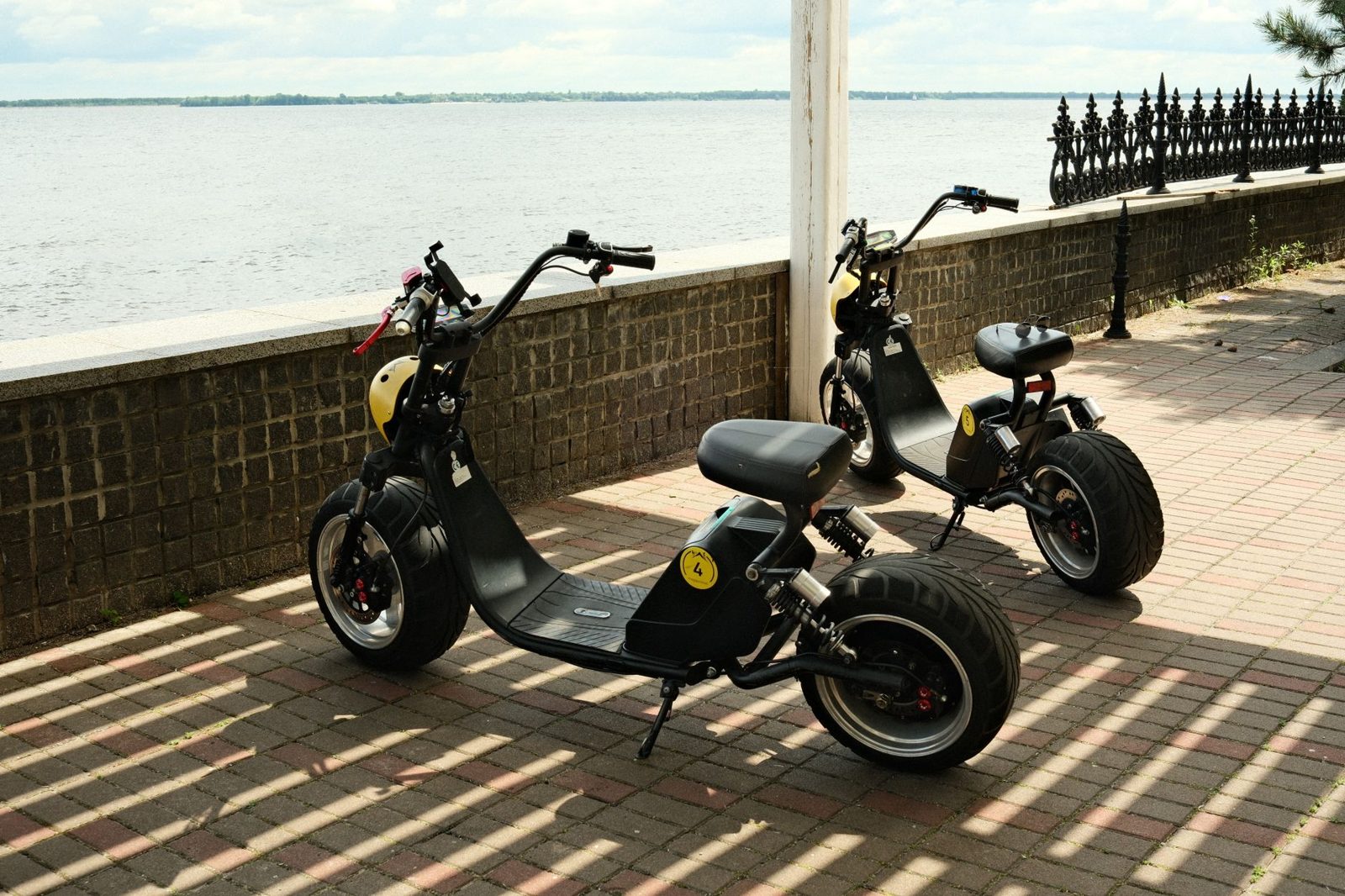
Quick answer: seated e-scooters add a saddle to a scooter platform, usually with bigger wheels. They can be more comfortable on longer rides, but they tend to be heavier, and a seat can take a scooter outside the legal definition of an e-scooter: Ireland and Ontario do not allow seats, and the European PLEV standard EN 17128 excludes seated vehicles that are not self-balancing. Check the rules before you buy.
Standing on a scooter for more than a few minutes can be tiring, especially for people with knee, back or balance problems. A seated scooter looks like an obvious fix. But a seat changes how the scooter rides, how heavy it is and, crucially, how the law treats it. This guide covers all three.
What is a seated e-scooter?
A seated e-scooter is a two-wheeled scooter with a saddle, either built in or supplied as a removable accessory. You sit with your feet on the deck and steer with the handlebars. They are different from mobility scooters, which are designed for people with limited mobility, usually have three or four wheels, and are covered by separate rules.
A real example
The Razor EcoSmart Metro HD is one of the best-known seated designs. Razor lists the following:
| Spec | Razor EcoSmart Metro HD |
|---|---|
| Recommended age | 16 and up |
| Maximum rider weight | 220lb (100kg) |
| Motor | 350W brushless rear hub motor |
| Top speed | Up to 15.5mph (25km/h) |
| Range | Up to 12 miles (19km) per charge |
| Battery | 36V sealed lead-acid (three 12V batteries) |
| Tyres | 16-inch pneumatic front and rear |
| Seat | Padded |
| Weight | 72.89lb (33.13kg) |
| Brakes | Hand-operated rear brake |
Two things stand out. First, the 16-inch tyres are much larger than the 8 to 12-inch wheels Consumer Reports says struggle on rough pavement. Second, the lead-acid battery makes it heavy for its range: at 33kg it weighs more than a typical lithium-ion commuter scooter such as Segway’s 24.3kg MAX G2, while offering a much shorter rated range.
Pros of a seated scooter
- Comfort: sitting spreads your weight and is less tiring than standing on longer trips.
- Bigger wheels: many seated designs use larger tyres, which cope better with bumps.
- Lower centre of mass: Consumer Reports identifies the standing position and higher centre of mass as reasons e-scooter falls tend to be head first. A seated riding position is lower, though it does not remove the risk of falling.
- Rider size: a seated position can suit riders who find balancing on a narrow deck awkward, though you still need to check the maximum rider weight.
Cons of a seated scooter
- Weight and bulk: a seat post, bigger frame and larger wheels add weight. They are harder to lift and store.
- Portability: seated scooters often do not fold as compactly, if at all.
- Handling: sitting reduces your ability to absorb bumps with your legs, and you cannot step off as quickly.
- Legal status: see below. This is the big one.
How a seat affects the law
- Ireland: the e-scooter rules that took effect on 20 May 2024 prohibit seats. A seated scooter is therefore not a legal e-scooter on Irish roads.
- Ontario: e-scooters in the provincial pilot cannot have pedals, a seat or a basket, and riders must stand at all times.
- Victoria: Victoria Police describes a legal e-scooter as having two wheels, a footboard and handlebar steering, with a 25km/h maximum speed and 45kg maximum weight. Check with the authorities whether a particular seated design qualifies.
- UK: private e-scooters of any design cannot be ridden on public roads, pavements or cycle lanes. A seat does not change that.
- Standards: the European standard for personal light electric vehicles, EN 17128, excludes vehicles with a seat that are not self-balancing.
Some sellers offer seats as an add-on for standing scooters. Fitting one may make an otherwise compliant scooter non-compliant in places where seats are banned, so check before you buy the accessory.
Lead-acid or lithium-ion?
Older and budget seated designs, like the Metro HD, use sealed lead-acid batteries, which are heavy for the energy they store. Most modern scooters use lithium-ion, which is lighter but carries a well-documented fire risk if damaged, modified or charged wrongly. London Fire Brigade says there is on average an e-bike or e-scooter lithium-ion battery fire every two days in London. Whatever the chemistry, use only the manufacturer’s charger and follow the charging advice from the National Fire Chiefs Council: charge while awake, unplug when done, and never charge on an escape route.
Where you can legally ride one
The rules depend entirely on where you live, and they apply to every type of e-scooter, not just the fast ones.
- UK: the government says it is against the law to use a privately owned e-scooter on public land. Private e-scooters count as motor vehicles, so they can only be used on private land with the landowner’s permission. Rental e-scooters in official trial areas are the legal exception, limited to 15.5mph and needing a full or provisional licence with category Q entitlement.
- Ireland: e-scooters became legal on public roads on 20 May 2024, with a 20km/h maximum design speed, 400W power limit and 25kg weight limit, and seats are not allowed. Helmets and hi-vis became compulsory on 4 September 2026, and the minimum age of 16 was due to rise to 18 in early October 2026.
- Australia: each state sets its own rules. Victoria defines a legal e-scooter as having a maximum speed of 25km/h and weighing no more than 45kg. Queensland caps e-scooters at 25km/h and 12km/h on footpaths, and from 31 August 2026 riders must be 16 with at least a learner licence.
- Canada: rules are provincial and often local. Ontario’s pilot runs to 27 November 2029 and allows scooters up to 500W, 24km/h and 45kg only where a municipality has passed a bylaw.
- US: Consumer Reports notes there is no federal safety standard for adult consumer e-scooters, and it tells riders to check local laws, which vary by state and city.
Is a seated scooter right for you?
If standing is the main thing putting you off e-scooters and you will ride on private land, or somewhere seated models are allowed, a seated scooter can be a comfortable option. If you want to ride on public roads in Ireland or Ontario, a seat rules the scooter out. And if a health condition limits your mobility, a mobility scooter designed for that purpose may be a better and more appropriate choice.
Sources
- Razor: EcoSmart Metro HD specifications (razor.com)
- Segway: Ninebot KickScooter MAX G2 specifications (ap-en.segway.com)
- Genorma: EN 17128:2020 Personal light electric vehicles, requirements and test methods (genorma.com)
- Consumer Reports: We tested 13 electric scooters. We don’t recommend any (consumerreports.org)
- London Fire Brigade: E-bikes and e-scooters fire safety advice (london-fire.gov.uk)
- National Fire Chiefs Council: E-bikes and e-scooters fire safety guidance (nfcc.org.uk)
- GOV.UK: E-scooter trials, guidance for users
- GOV.UK: Guidance on powered transporters
- RTE News: What are the new e-scooter regulations? (May 2024) (rte.ie)
- RTE News: New helmet and high-vis e-scooter regulations in effect (September 2026) (rte.ie)
- Victoria Police: Electric powered scooters (e-scooters) (police.vic.gov.au)
- Queensland Government StreetSmarts: E-scooters, e-skateboards and e-unicycles (streetsmarts.initiatives.qld.gov.au)
- Government of Ontario: Electric kick-style scooters (e-scooters) (ontario.ca)